
%20(1280%20x%20720%20px)%20(44)%20(1).png)
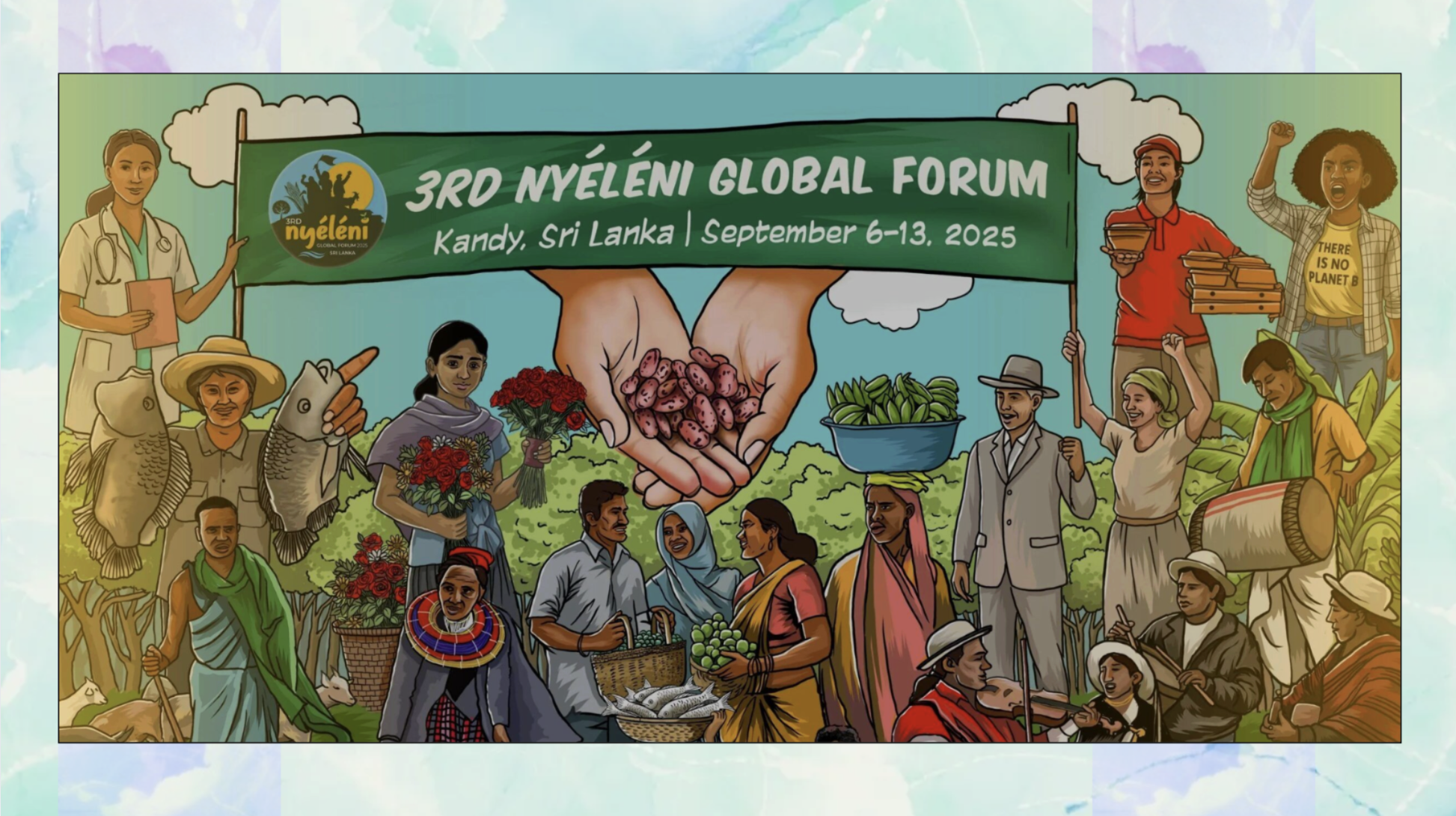
In September, hundreds of grassroots and movement leaders from around the world gathered in Sri Lanka for the third Nyéléni Global Forum for Systemic Transformations.
This was the third global Nyéléni Forum, following gatherings in Mali (in 2007) and Mali (in 2015), which first defined food sovereignty and then deepened the understanding about agroecology as one of its main pillars. This year’s forum built on those foundations – shifting from definitions to collective action and systemic transformation.
It marked a major milestone for the international movement for food sovereignty – and beyond – bringing together farmers, fishers, Indigenous leaders, as well as activists from the climate justice, social and solidarity economies, people’s health movements, funders and many others in dialogue about power and solidarity.
We spoke with two members of the Nyéléni global steering committee: Paula Gioia, a small-scale farmer and beekeeper in Germany and a member of La Via Campesina; and Saúl Vicente Vásquez, a Zapotec leader from Mexico and member of the International Indian Treaty Council. The following conversation has been adapted for length and clarity.
At the closing ceremony in Sri Lanka, the Common Political Action Agenda was described as a living document. Can you explain what that means and how it’s being developed before and after the Forum?
When we say it’s a living document, we mean that it’s not fixed – it’s part of an ongoing, collective process. The Nyéléni Forum was never meant to be a one-off event. It’s a milestone in a much longer journey of convergence and movement building.
In previous forums, we focused on deepening concepts – like defining food sovereignty in 2007, or setting the pillars of agroecology in 2015. This time, it wasn’t about a new definition. It was about creating broad convergence toward systemic transformation. The agenda was already being built through two years of regional consultations and global movements discussions before Sri Lanka. We arrived at the Forum with a draft of our Common Political Action Agenda that guided our debates, and we’re still integrating the inputs that came out of those sessions.
So when we call it “living”, it’s because it grows through action. It connects the local and the global – territorial struggles feed into the global agenda, and vice versa. For example, as Saúl will share, movements in Mexico are already advancing concrete actions that emerge from this shared process.
Exactly. The agenda will continue to evolve through upcoming international and regional gatherings. We’ve agreed to launch the official outcomes of the Forum during the People’s Summit happening in parallel to COP30 in Brazil, and to carry out advocacy at spaces like the UN Conference on Agrarian Reform and Rural Development (ICARRD+20) in Cartagena in February 2026.
We’ll also bring these discussions to places like Mongolia during the global pastoralist meeting in parallel to the UN Convention to Combat Desertification (August 2026) and to events recognizing the International Year of Women Farmer (2026). In Mexico, we’re organizing an event this December at the Supreme Court to commemorate the anniversary of the adoption of the UN Declaration on the Rights of Peasants and Other People Working in Rural Areas.
All of this shows how the agenda lives – through coordinated action, solidarity, and the implementation of international legal frameworks like the UN Declaration on the Rights of Indigenous Peoples and the Declaration on the Rights of Peasants and Other People Working in Rural Areas.
I want to ask about the role of philanthropy. It’s clear this movement isn’t driven by funders – but money and solidarity both play a role. What did you learn from the funder dialogue at the Forum?
It was a very important moment. For the first time, social movements and donors met not to discuss projects or grants, but to build a foundation for shared political commitment. We called it a dialogue between solidarity philanthropy and social movements.
We reached a common understanding: this is not about “funders and recipients.” It’s about allies in a shared struggle for transformation. The aim is to develop mechanisms for decolonized, trust-based funding, where social movements retain autonomy to define priorities, and philanthropic partners act in solidarity – not as gatekeepers.
Yes. It’s important to clarify that the Nyéléni Funder Circle is still being formed – it wasn’t yet established during the Forum itself. Over the past three years, we’ve worked through the International Planning Committee for Food Sovereignty (IPC) to design strategies for financial autonomy—not just fundraising for one event, but ensuring long-term sustainability for our movements.
Through that process, we saw philanthropy evolve in parallel. While social movements articulated financial autonomy, funders began developing the concept of solidarity philanthropy. The two go hand in hand.
We want to move away from the language of “donors and beneficiaries.” Names matter—they shape mentalities and narratives. What we’re building is not a “circle of funders,” but a circle of solidarity where movements and aligned funders meet as comrades. Sometimes the support comes through money. Sometimes it’s through advocacy, or by bringing in new potential allies. What matters is reciprocity, shared purpose and mutual trust.
What does success look like for this emerging partnership?
Success means long-term relationships built on trust, transparency, and shared values. Solidarity philanthropy is not charity—it’s political alliance. We’re working toward financial systems that allow movements to act autonomously, using funds aligned with our principles. That includes full transparency about the source of the money.
We must ensure this partnership doesn’t repeat the patterns of co-optation or dependency we’ve seen in other spaces. The movements must remain autonomous. But if we can sustain trust-based collaboration, we’ll achieve true financial autonomy—and that’s one of the most important takeaways from Sri Lanka.


.webp)
%20(1280%20x%20720%20px)%20(37).png)
.webp)
%20(1280%20x%20720%20px)%20(34).webp)