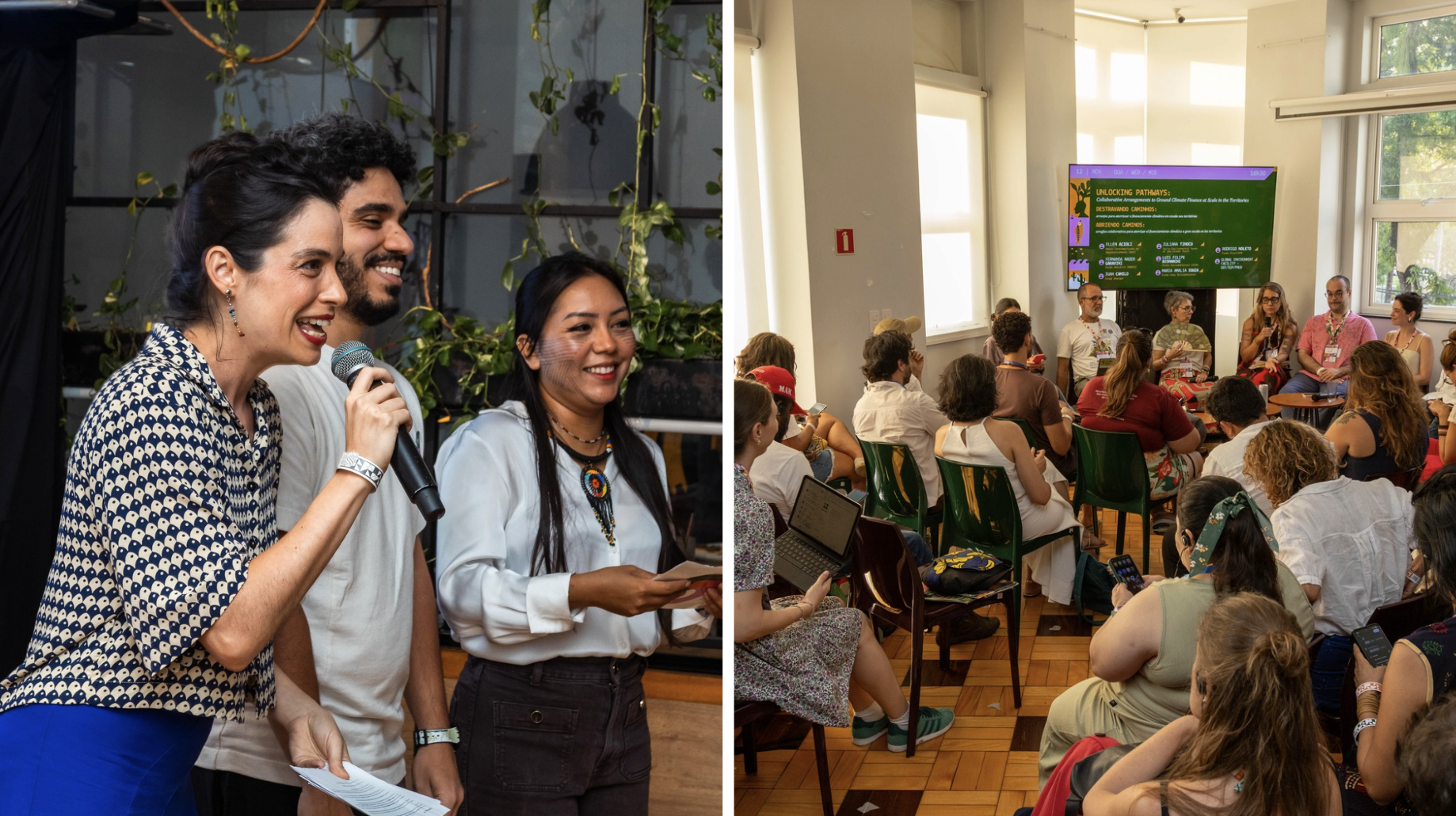


It’s conference season. Over the coming months, many of the people who shape philanthropy and development finance will once again meet in global spaces to discuss climate and nature financing.
Last year, our team at the Global South House released a Manifesto for a New Financing Architecture for Climate, Nature, and People. We called for an architecture that is more legitimate, responsible, and just, and described how the financing ecosystem can be grounded in active listening, mutual trust and solidarity.
This is not a wish list or an exercise in abstractions. The funding models that the manifesto describes are already in place, operated by socio-environmental justice funds from the Global South. Our role at the Global South House is to bring these actors into relationship with each other and with the wider funding world.
The question for the rest of the funding world is no longer what a better system could look like. It’s whether they will put real money behind what is already being built. Below are a few ways that funders can support this emerging Global South financing infrastructure.
Start before there is a funding strategy
We often invite local actors into conversations. We are less consistent at allowing those conversations to change where money goes.
If people closer to the issues are genuinely expected to shape how resources are used, they need space to set agendas, identify priorities, compare experiences and develop ideas together, including ideas that do not fit neatly within an existing donor strategy. Some of the most important work happens before there is a project to finance, and those relationships need time.
This could mean funding spaces where local actors can shape priorities before a funding strategy is set. It could also mean funders sharing due diligence, learning and relationships rather than repeatedly asking the same organizations to prove their legitimacy to each institution.
Relationships themselves are a form of wealth and sharing them means more than making an introduction. It can mean opening funder networks, pooled mechanisms, policy discussions and sector-shaping spaces in ways that allow locally rooted actors to build relationships independently and remain in those spaces beyond a single project.
A good funding relationship should leave local actors with more access and relational capacity than they had when it began, not simply with a completed grant. Listening and relationship-building are not the soft work around financing. They are part of its infrastructure.
Move decisions closer to the knowledge
Direct support matters, but a shorter financial chain does not automatically make funding more locally led. What matters is how close funding decisions are to the knowledge needed to make them well. That suggests a different understanding of proximity.
Our Manifesto argues that communities confronting climate, environmental and social challenges should be represented in resource-allocation decisions. It also recognizes the role that locally rooted funds can play in connecting territorial realities with larger pools of capital.
For funders, this can mean changing who sits on decision-making bodies, giving local partners real authority over allocations, and allowing funding decisions to adapt when circumstances change, rather than requiring every deviation to be approved from afar. It also means considering risk from the perspective of the people closest to the consequences.
Use what is learnt to change the system around the funding
Better grants are necessary, but they are not enough. We can improve how individual grants are made, but the wider rules of the system will continue to shape where capital flows, what is considered credible, and whose solutions are seen as investable.
What we learn through locally rooted funding needs to travel into the institutions and systems that shape how capital moves: philanthropy, public finance, multilateral mechanisms and global policy spaces.
A locally rooted fund may develop a different approach to risk, accountability or evidence because it is working in a particular territorial context. That experience can do more than change one funder’s practice; it can challenge assumptions across the wider system.
Funders can also use their networks not simply to advocate on behalf of locally rooted actors, but to expand those actors’ own access to the relationships and spaces where funding priorities are set, as actors able to build relationships and exercise influence in their own right.
Ultimately, this is about increasing the ability of Global South actors to shape the funding architecture itself.
Fund the capacity to act together
Many climate, nature and social justice challenges cross sectors, geographies and forms of capital. Funding, meanwhile, still tends to divide them into projects, portfolios and predetermined outputs.
Different solutions also need space and resources to develop. This can mean supporting collaboration before the final outcome is known, funding pilots that may evolve, giving organizations room to test financing mechanisms or partnerships, and resourcing the coordination required to bring different forms of knowledge, capital and institutional power into the same process.
This also means investing in the institutions that make this work possible. Across the Global South, locally rooted funds already combine territorial knowledge, long-term relationships and the capacity to work with larger funding institutions.
Yet there is still a gap between what philanthropy says it values and how it funds. We may value long-term relationships, local knowledge and institutional capacity, but still structure support through short-term grants with predefined deliverables and metrics. Even participatory processes can end up reproducing the same hierarchy between funder and funded.
If these institutions are part of the financing infrastructure we need, they require flexible, long-term resources to strengthen teams, systems, knowledge, relationships and financial sustainability. That is not overhead around the work. It is part of the work.
What comes next?
For Global North funders, the next step is to make this conversation more practical and to think about what can be done collectively.
Where can due diligence be shared rather than duplicated? Which locally rooted institutions need long-term investment to become stronger parts of the financing ecosystem?
Which relationships, networks and decision-making spaces can funders open so that local partners leave a collaboration with greater access and influence than when they entered it?
What could funders do together that none of them could do alone?
Active listening, mutual trust, solidarity and direct support become much more concrete when we ask those questions together. The foundations of a different funding ecosystem already exist. The opportunity now is to strengthen them and move more capital through them, collectively, and at greater scale.
At The Global South House, we exist to help carry this collective construction forward, bringing people, institutions and ideas into relationship so that new ways of moving resources can be built together.
Juliana Tinoco is the Lead Architect and Implementer of the Global South House.