
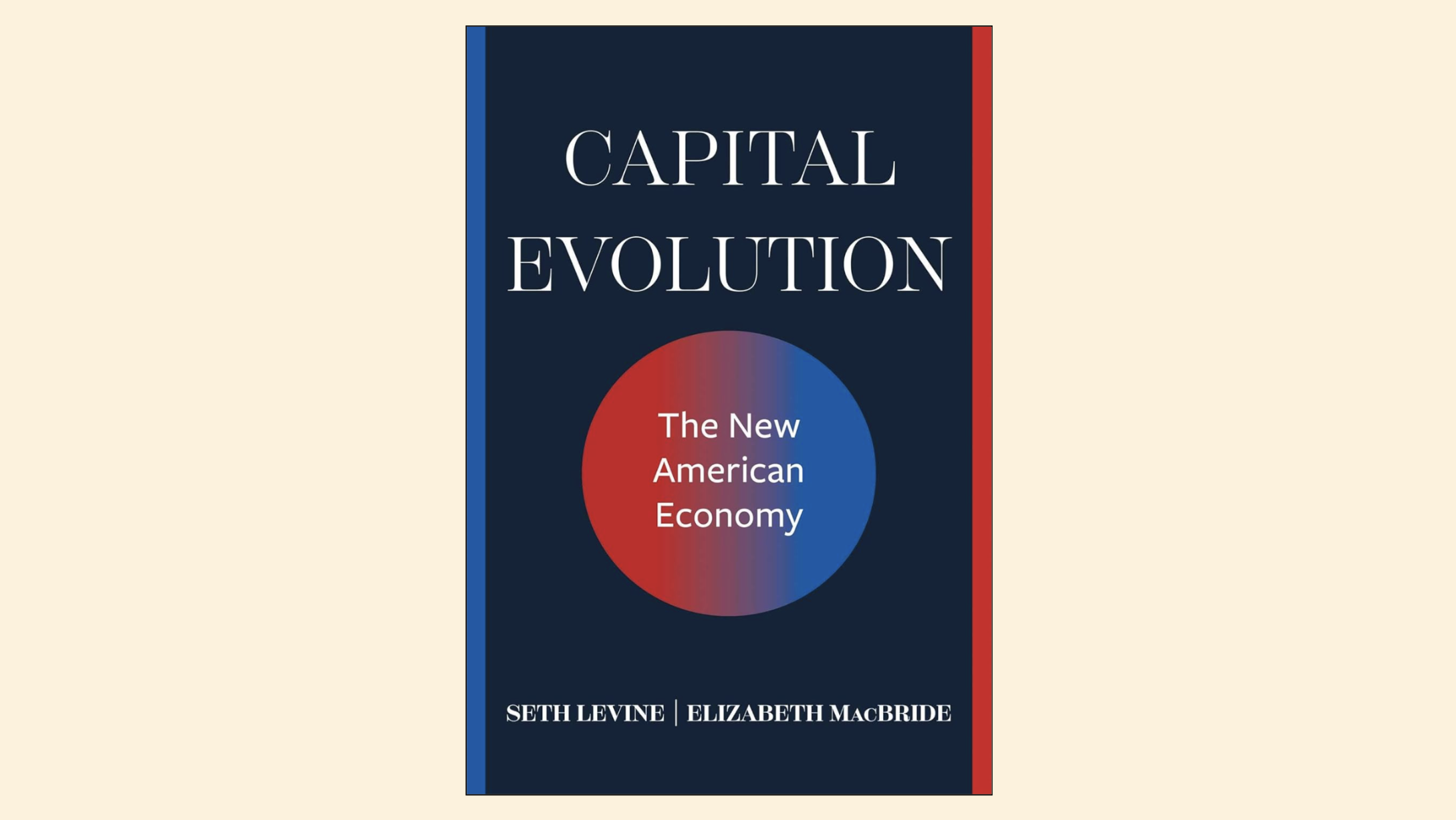

In our book, Capital Evolution: The New American Economy, we observe and argue for a new movement to restore the United States economy to a more sustainable, equitable version of capitalism. The four principles of Dynamic Capitalism are:
- A longer-term orientation by business leaders
- Increased economic mobility to rebuild the middle class
- Accounting for externalities, so that new innovations restore the environment
- Rule of law
To restore the middle class, one of the best ideas is to create more owners of businesses. We argued for this as well in our previous book, The New Builders. In Capital Evolution, we broaden these ideas to include people who aren’t necessarily entrepreneurs but who still need access to the wealth-building a healthy capitalist system offers.

In 2021, Rick Plympton and Mike Mandina reflected on the company they had built over the past 30 years. Since founding Optimax, they have achieved success by almost any measure. Companies around the globe were using their high-end optical lenses. NASA was even using Optimax products in space.
Over the years, the company had generated about $500 million in revenue, with more than half of that - $250 million - paid out to employees in the form of paychecks, supporting the community the men loved, Rochester, N.Y.
They founded Optimax after meeting as blue-collar workers on the production line at Kodak. The company decided not to pursue a product the men had invented because managers there thought the market potential was too small. The two men took a risk at the beginning, and they believed it was right to be compensated for that risk and their hard work over the years, but what they saw among some company owners and CEOs across America bothered them.
“It’s frustrating that you can have a company where they pay their workers as little as possible, and the leaders take boatloads of money,” Plympton said. “That’s a perversion of capitalism.”
Now, as they considered the next chapter in their lives, it was time to look at succession plans. Should they sell the company? Would a buyer treat their employees – 500 by that time – fairly and keep the company’s sharp reputation for quality?
“We didn’t like the conventional ways to sell your business,” Plympton said. Looking for a different path, they eventually discovered a model called an Employee Ownership Trust. Popular in the United Kingdom (where there are tax incentives benefitting this structure) and in a few other countries, it remains relatively obscure in the United States.
But it and other models of ownership - especially Employee Stock Ownership Plans (ESOPs), which we’ll discuss in a few paragraphs - hold great promise. As we researched ways in which the capital and labor classes can come together to create value, we were struck by the potential of creating a larger class of “owners” in America and the role that various forms of employee trusts and stock plans might play in this transition. Because they create incentives for employees to add value to their companies, these models stand a good chance of garnering support from business leaders, especially those with a long-term orientation.
An Employee Ownership Trust is a way to transfer company ownership into a benefit trust on behalf of the company’s employees. It is just one example of a growing movement in America to expand ownership in ways that move outside the economic paradigm of neoliberal capitalism and its emphasis on the differences between capital and labor. In the norms and structures of the past 50 years, “capital” has been central. In the neoliberal style of capitalism, shareholders are the first and most important beneficiaries of companies’ activities. Shareholder earnings are taxed differently than labor, and, in general, government policies - not to mention social status - skew heavily towards the capital class.
However, a growing number of people are looking for new economic frameworks that seek to rebalance capital and labor. Strikingly, many of the leaders of this movement come from blue-collar backgrounds. As in the case of Optimax’s owners, they are aligning incentives and broadening ownership while still compensating capital (investors) for the risk they take. At the same time, these new structures allow workers to turn their labor into ownership.
This trend is not about creating a welfare system or an altruistic move to impose one set of values across the business ecosystem. Instead, it is about creating mechanisms to rethink how profits are shared within an organization. A growing number of people – including the two of us – advocate for expanding the idea of ownership as one of the best mechanisms for closing the gap between the wealthy and the middle class.
The Mechanisms of Wealth Sharing
Founded from the innovation of film technology, Kodak, the company where Rick and Mike worked, was famous for wages and benefits that helped elevate families into the middle class.
Yet, when another innovation came to the fore, the digital camera, Kodak failed to adapt. And though other companies arose to produce the cameras consumers wanted, the companies didn’t need the same number of workers.
Take, for example, Apple. It had 161,000 employees in 2023, sales of $383.3 billion, and profits of nearly $100 billion. At its peak, in the early 1990s, Kodak had 145,000 employees and sales of $19 billion (with profits of $2.5 billion). On the one hand, it’s positive for America that we have built some of the most profitable companies in the world. On the other hand, part of what drives that profitability is that many businesses no longer need large numbers of workers to generate their revenue.
If you focus just on individual companies, what you see looks like a series of deaths and rebirths, of invention and reinvention, and of new market entrants surpassing entrenched and older businesses that failed to adapt. If you look at capitalism as a system, you see companies as mechanisms for delivering value and profits. Companies deliver value to consumers and make profits, which are distributed to workers in the form of wages and to owners in the form of returns.
Through this lens, you can see that the old mechanism for creating and distributing economic gains throughout society - companies that needed many workers and some that were distributing profits to a growing swath of society through the public markets - started failing in the 1980s. Kodak was a distribution engine in another way, with its founder, George Eastman, becoming a philanthropist who focused on institutions that contributed to economic mobility and a social safety net.
America’s innovation engine is working. Optimax is just one example of many in which ingenuity combined with risk-taking resulted in a new technology that created value. However, companies are no longer the mechanisms to share profits between owners and workers that they once were. This has been a profound change in our economy and one that has disproportionately hit the middle class.
You can see the trend by comparing the growth of wages versus corporate profits - a rough measure of how corporate revenue gets distributed between workers and shareholders. For most of the last century, wages and profits have grown roughly in line, meaning the relationship between return to capital and return to labor was relatively static.
Starting in the mid-1990s, however, these trend lines diverged, with profits increasing at a significantly higher rate than wages, according to data compiled by the Federal Reserve. This once fundamental mechanism of economic mobility and stability has broken down. Capital has been favored over labor in ways that are dramatic to observe and pernicious to the long-term health of our overall economy.
Politicians tend to talk about aggressively redistributive tax policy, typically favoring particular interest groups or the people they see as their most important constituents. You could write a whole book on tax policy, which is not our purpose here, but three things are clearly true: a complex tax code creates perverse disincentives, those disincentives hamper economic fairness and growth, and the U.S. government will need more revenue in the coming years, not less. Whatever your view on the specifics of tax policy, it is essential to build a stronger middle class whose incomes are rising faster than their taxes are going up. This will create an overall stronger economic base upon which to build.
To allow more workers into the capital class, we should build greater legal and tax incentives to encourage owners to share the risks and rewards of ownership. Turning workers and consumers into owners with a corresponding long-term orientation to the future is an important step toward realigning incentives across our society. Dynamic Capitalism, the movement we argue for, promotes these aligned incentives.
We’re not alone. KKR, the giant investment firm started by George Robers, the ardent capitalist and early pioneer of social entrepreneurship we introduced in Chapter 8, has made promoting an ownership economy one of its three central strategies for growth. Within KKR, Pete Stavros, the co-head of global private equity, was an early champion of these ideas. Like Rick Plympton and Mike Mandina, Stavros grew up in a working-class family. His father operated a road grader as an hourly worker in Chicago for more than 40 years.
“When he retired, he was making $15 an hour. But he had a lot of power in his union because he was the most experienced, best road grader. That gave my dad some stature and some ability to push for things,” Stavros recounted to us.
But the elder Stavros found the hourly pay demeaning.
“He used to talk about this misalignment of incentives. So if you work too fast, your hours go down, your paycheck goes down. There is this weird, perverse incentive to not try that hard. And my parents are both absolute workaholics.” At one point, the company stopped paying workers for their lunch hour. So his father arranged to have road aggregate delivered at lunchtime. “My dad would look at his watch and say, we don’t work now,” he said. “So he would refuse delivery of the road aggregate, and then he would run the job out of material and shut the job down.”
Watching his father’s battle with the company left a deep impression on Stavros. For one thing, it convinced him that paying only by the hour was a “stupid” way to pay people. However, nearly 70 million people in America are paid hourly. So when Stavros became the head of the manufacturing group at KKR, he decided to try something different with six of the companies in the private equity firm’s portfolio. He modified equity plans traditionally reserved for management and expanded them to include all employees.
When KKR sells companies where they have implemented these ownership plans, employees share in the gains from that sale, in some cases receiving payouts that are multiples of their annual wages. Based on its early success with broad employee ownership, KKR has implemented employee equity structures across at least 35 companies, including CHI Overhead Doors, Minnesota Rubber and Plastics, Frontmatac, and CIRCOR International. Managers found that employee retention and engagement go up, and in the best cases, employees can get life-changing payouts. When KKR sold CHI Overhead Doors in 2023, the average worker received $175,000.
Of course, workers may not get those payouts. Not all the companies in KKR’s portfolio do well or get sold. And the strategy isn’t altruistic, Stavros reminded us. If KKR can turn a company around faster, it will make more money, and the bulk of the profits still go to the owners of KKR itself. (Anyone can become an owner of KKR these days; the company is listed on the public stock exchange).
This type of widespread ownership model has long been common among venture capital-backed startups in Silicon Valley and beyond. Fairchild Semiconductor, founded in 1957, pioneered the use of stock options in Silicon Valley. The practice spread through the 1960s and 1970s as technology companies laid the foundation for what would become decades of innovation. Early tech companies such as Intel Corporation and eventually Microsoft, Apple, Oracle, and others made wide use of stock options to incent employees, and the practice has become nearly ubiquitous. Today, nearly all technology startups - whether located in Silicon Valley, Boise, or Stockholm - provide stock options to employees to align corporate interests and share the “upside” of their business performance.
The result has been many high-profile successes where large numbers of employees see a meaningful windfall when a business either goes public or sells. When Facebook went public in 2012, a reported 600 employees became millionaires. Mark Cuban has boasted that more than 90% of his employees became millionaires when he sold his company, Broadcast.com, to Yahoo in 1999. Perhaps it is the result of the risk-taking culture of tech startups, but the result has been a system that nearly ubiquitously rewards employees as owners and allows everyone from senior executives to hourly workers at these businesses to share in a company’s success. This labor-to-capital pathway is one that a broader set of business leaders can learn from.
The ESOP model (and other related legal structures) transfers some of these ideas to companies outside the tech sector. For now, there are about 6,500 ESOPs across the country, covering about 15 million participants and holding more than $2.1 trillion in assets. As of 2021, 11 million employees participated in equity compensation plans such as restricted stock, stock options, and employee stock purchase plans. Other workers are employed in worker cooperatives, and still more are beneficiaries of employee ownership trusts like the one at Optimax, which distributes profits on an ongoing basis to workers, rather than through a one-time sale, as in the case of the companies owned by KKR.
Approximately 18% of U.S. employees have an ownership stake in their employers. That’s a great start and something we should aggressively build upon. Employee ownership doesn’t need to be unique to technology businesses or a few forward-looking business leaders. In the early 20th century, employee profit participation was much more common, and many companies, including Sears, Pillsbury, S.C. Johnson, Hallmark, and U.S. Steel, shared earnings with their workers. We can learn from the past.
The AI Disruption is Coming
ESOPs and stock options are models that supplement the other ways Americans can own companies, either through the stock market or by becoming entrepreneurs. These models are becoming more important now as the pace of technological change accelerates.
We don’t know how machine learning or AI will change the job market or economy in the United States or globally, but surely it will have an effect, just as automation did in the 1990s. Innovations create economic value, but we are only concerned with aggregate economic growth; we also want to create a system where the benefits of the growth are shared.
Read more in Capital Evolution: The New American Economy.
%20(1280%20x%20720%20px)%20(39).png)


.webp)
.webp)


