
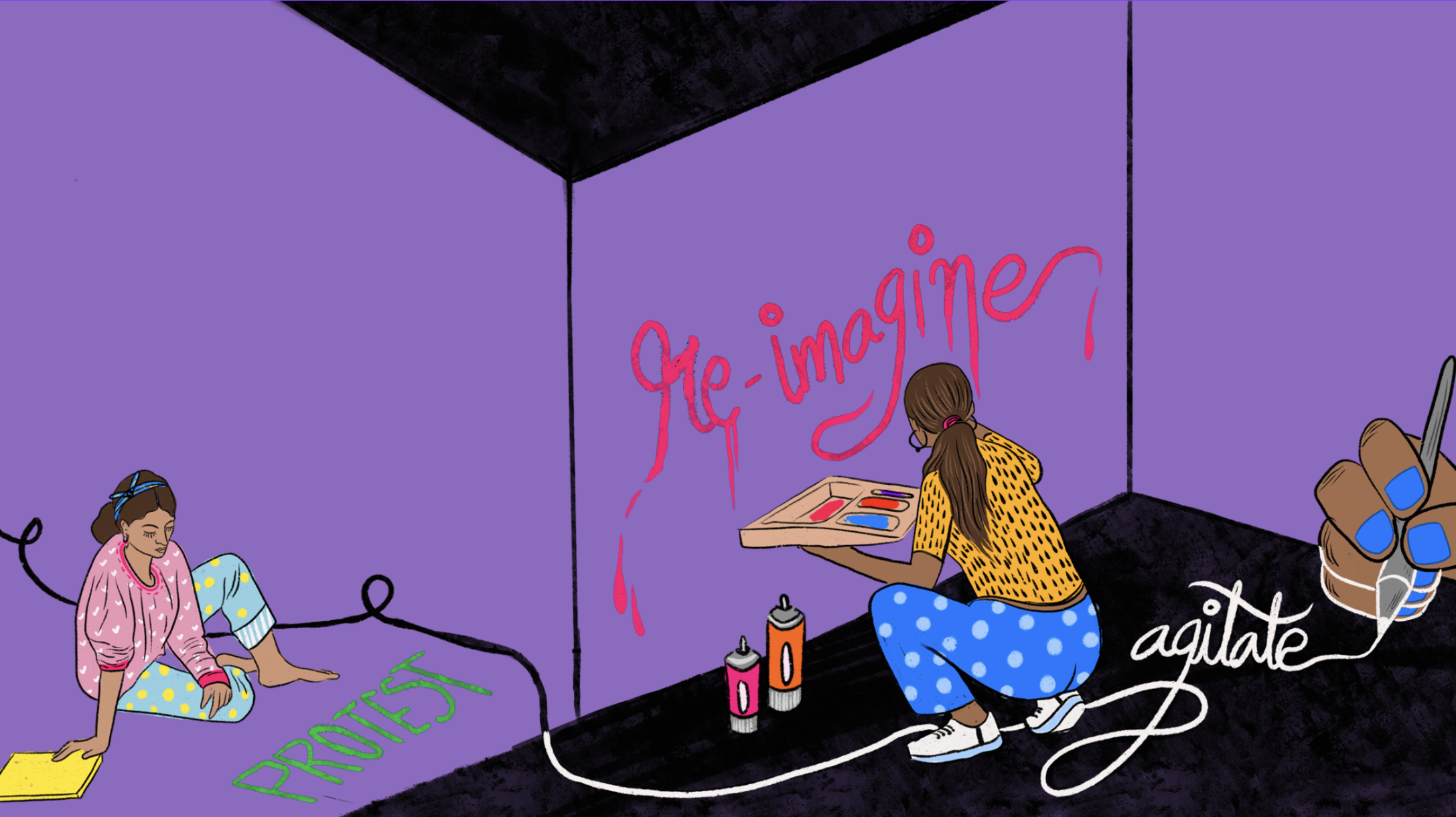

For centuries, art has sparked collective awakening and fueled movements for equity and justice.
Across the globe, it has not only reflected social realities but has also shaped them: from Chilean arpilleras documenting state violence under Pinochet to Nigerian Afrobeat as Fela Kuti’s instrument of resistance to murals, photographs, carnival and dance that fueled anti-colonial and resistance struggles across India, South Africa, Trinidad and Tobago, Brazil, and many more. Art has always been a vehicle for collective awakening, a site of truth telling and a portal into possibility.
There are many hypotheses for why art holds this transformative force. One clear explanation is the power of imagination. Artists conjure images, sounds, and stories that act as mirrors—reflecting the times with clarity and courage. They also create “funhouse like” distortions that reveal the absurdity of oppression and expose contradictions in dominant narratives.
And once these absurdities are seen, they can’t be unseen, making space for new narratives and new worlds to actually become plausible. Through art, we glimpse realities that do not yet exist, but could. It fuels our rage, expands our thinking, and gives us hope to keep fighting for what has not yet arrived.
Immersive artistic experiences go even further. They often function in third spaces, such as community centers, libraries, and parks. These are places outside of the home and institutions like schools and workplaces that can provide relief from day to day pressures. These experiences are where people can be fully absorbed, connected and seen. They cut through isolation and foster collective presence, providing a salve for the increasing epidemic of loneliness.
This powerful phenomenon not only evokes emotion and attention, but can generate a sense of belonging required for collective action. Neuroscience and social psychology show what our ancestors have always known; shared creative experience and storytelling strengthens empathy, cooperation, and social cohesion, and that leads to new emergent stories of how we see ourselves and our place in the world.
The experiential design agency Cheerful Twentyfirst notes that experiences can definitely grab attention. We have seen this with flashmobs, viral videos, and social media fads. However, the real work is holding people’s attention long enough to shift perception, and eventually attitudes and behaviours. Their framework describes the highest form of engagement as the “golden goose”: a state of cognitive absorption in which audiences are fully immersed and emotionally attuned.
In their words, this is “total immersion in an activity, characterised by deep enjoyment, a feeling of control, curiosity and not realising the passing of time… a flow state.” This is precisely what many artists create — conditions where people have an embodied experience, where imagination expands, and where new possibilities become not only visible but believable. In these shared states of absorption, art becomes more than expression; it becomes an engine of cultural change.
We have seen this immersive, world-opening power firsthand. Our exhibit, Building New Worlds, that we co-created with multidisciplinary artists, invited visitors directly into the complex world of girls, non-binary youth and young feminists. The exhibit brought together images, poems, performances and digital works that centered on girls’ dreaming, power and resistance from around the world, treating the imaginations of young artists not as whimsical pleasantries but as blueprints for life-affirming futures. More than an installation, it was an invocation—a collective act of resistance and possibility-making.
Community members described the experience as emotionally transporting, a space where intergenerational connection, creativity, and political clarity converged. In Building New Worlds, art became both evidence of what girls are already building and an active practice of narrative power building and worldmaking in real time.
“Walking into that exhibit felt like witnessing a young girl’s dreams being taken seriously in real time. The drawings pulled me in immediately—faces, colors, visions already alive and in motion. Each piece showed how girls are making meaning of their worlds and creating new possibilities. The mix of art forms—poems beside paintings, installations next to digital work—reminded me that liberation requires many languages and many tools. As a mother, I felt a deep exhale seeing children welcomed so intentionally. My whole self was invited in. This is how we pass vision across generations: by creating spaces where we can all breathe, learn, and dream together.”
“The exhibit reminded me that girls and young women in all their diversity are envisioning and crafting the futures they want—often against all odds, and in defiance of the voices that tell them they cannot dream this way. Being immersed in their dreaming, power, and resistance evoked a sense of curiosity, creativity, and expansiveness. I felt it at a cellular level. And how extraordinary to feel that kind of possibility in the times we are living in.
Another vivid example is the work of Our Collective Practice’s Narrative Revolution Fellow and young feminist artist, Tere Marcial, who merges hip hop with traditional Indigenous son jarocho music to create performances that are both contemporary and rooted in Indigenous tradition. Her music circles, festivals, and lyrical poetry bring people into a shared rhythm like a literal synchronizing of mind, body and spirit. This ‘cognitive absorption’ is made communal: music that draws people so fully into the moment that time loosens its grip. Grounded in community, land, and lineage, she writes and raps about “her perspective on the world and how people can relate to one another and live better.” Her intersectional work transforms public spaces, reaches diverse audiences, and subtly but powerfully shifts consciousness.
In fact, girls and young feminists are often at the forefront of transformative change through their art and creative practices. Research on girls’ and young feminists’ strategies for systems change shows that art and creativity are among their most powerful tools. Often working with few resources except for a profound sense of radical imagination, they challenge cultural norms and infiltrate narrative terrains long monopolized by power holders. Stories of Girls’ Resistance, the largest global archive of girls’ activism, found that girls rarely draw a line between “art” and “organizing.” Their power building is inherently imaginative. They use murals, music, performance, storytelling, and play to shift culture long before they ever shift policy. And as is well proven, cultural transformation through artist-led narrative strategy is the prerequisite to political and economic change.
Moreover, this imaginative, boundary-pushing power is not confined to local spaces; it stretches across geographies. Digitized art connects people across distance and lived experience.
One example is this Plurilogue, a transnational storytelling project created by Erin, which brings girls’ resistance stories into direct political conversation with one another. Produced by Our Collective Practice, the Plurilogues invite audiences into the worlds of characters such as Wisdom, Sacrifice, and Shape Shifting—voices hailing from Palestine, Nicaragua, Iraq, Ukraine, The Gambia, and beyond. Those who perform, read, or listen can enter another girl’s world so deeply that it reverberates back into their own—a form of cognitive and emotional travel that only art makes possible. When designed as immersive experiences, what experiential designers describe as the “golden goose”, this work deepens understanding, builds solidarity, and expands political imagination.
And yet, despite the profound impact of art as strategy – young artists – especially those who are Black, Indigenous, Dalit, queer, trans, disabled, and living at the sharpest edges of marginalization in the global majority remain profoundly under-resourced and highly extracted from. These are the visionaries who hold the clearest understanding of the way structural oppression operates and therefore have the brightest visions for what intersectional metamorphosis looks like. They generate the most transformative work of our time and their art has the power to shift culture faster and more durably than any political leader or other gatekeeper ever could. But they are routinely asked to create without security, institutional support, and recognition as essential architects of social change.
As we know, 2025 was a devastating year for artists all around as geopolitical forces and rising authoritarianisms continue to upend our social fabric, disrupt economic security and wreak havoc on our planet. AI generated content, the consolidation of mega media and entertainment studios, and supply chain disruption will continue to reverberate and impact our artist activists globally.
This current reality raises urgent questions including: 1) What role can funders play in resourcing girl and young feminist artists who bring communities together, expand our political consciousness and contribute to collective futurism? and 2) How might funding narrative and cultural strategy ecosystems support the artists who are already building the worlds we need? Our recommendations are as follows:
1. Fund Art In the Long-Term As a Key Driver of Systemic Change
Evidence has proven over and over again that art can change the world and in this current reality we need funders to trust and believe in the power that artists have to bring communities together. The hot off the press impact report of the Constellations Culture Change Fund & Initiative recommends that funders invest in artist disruptors and culture bearers as they are the “lifeforce behind narrative and cultural strategy and often face funding inequities.” The report posits that they are “frequently overlooked in light of more established narrative players—like think tanks and strategic communications firms—which usually lack the deep, ongoing connections to communities and Indigenous, traditional, and ancestral narratives that are essential to combat colonialism, domination, and erasure.”
Funders must invest in artist-led activism and narrative power building across all thematic portfolios such as gender, racial and climate justice. Moreover, funders need to support immersive art experiences that bring people together to shift perception and behavior as the first step towards policy change. This will require that funders understand that cultural transformation takes time, repetition and depth to fruit. Just like trees, cultural change needs perpetual sunlight and water over many seasons to bloom. We can’t just rely on one-off exhibits or short-term campaigns, and think we will shift our entrenched harmful narratives.
We need funders to believe in unrestricted, long-term investment, focussing out over the horizon at 10-year plus intervals. Unfortunately, this will take a substantive sea change, as traditional philanthropic metrics often flatten artistic and cultural work when it is funded, prioritizing visibility, polish, and productivity over depth, process, and community connection. Funders must redefine success to value experimentation, pivots, speculative storytelling and non-linear emergence rather than demanding predetermined outcomes. Creation not compliance, must be the north star.
2. Fund Girl and Non-Binary Young Artists as Core Strategists
It matters who is producing the art and driving the new narratives, and girls and young feminists, embedded in community and lineage, must be recognized as central agents of change, not simply supporting characters.
Girls and non-binary young people experience systemic oppression most acutely, and innately use art, creativity, and play as ways to color outside the lines of oppressive systems. Their epistemologies expand what is possible for movements and for philanthropy itself, and they must be prioritized as core strategists. In this vein, funders need to work together to fund the ecosystem of narrative actors, which not only includes the organizations that flank movements, but the individual young artists embedded in communities. We need more resourcing models and risk taking when it comes to funding such as fellowships, residencies and universal basic income for artists.
Recent learning from Our Collective Practice’s Narrative Revolution Fellowship, demonstrated that when girls and young feminist artists are adequately resourced with trust, time, and autonomy, their work moves beyond representation and toward genuine culture shifts. Across the fellowship, artists emphasized that narrative power is not produced through isolated outputs, but through sustained processes of imagination, immersion and relationship-building.
3. Fund Narrative and Cultural Strategy Infrastructure and Community Well Being
Finally, both Constellations Fund and the Narrative Revolution Fellowship highlight the need to resource not only creative work itself, but the conditions that make it possible, including robust infrastructure, accompaniment, and care-centered approaches that recognize artists’ full humanity. Culture change does not happen through isolated grants; it is sustained by ecosystems.
Artistic and narrative work is inseparable from broader community well-being so investing in the infrastructure that allows artists and movements to thrive over time—including individuals, networks, collectives, shared platforms, convenings, and learning spaces—while recognizing care, rest, accessibility and safety as foundational conditions, not peripheral supports.
One straightforward way that funders can implement this ecosystem approach is to ask grantee partners who else in their community can they fund to support the knitting together of values-aligned individuals and organizations focused on transformative narrative shifts. The Kataly Foundation mentioned this strategy in a recent podcast published with Grantmakers in the Arts. This supports a more resource abundant story that does not pit artists or groups against each other for valuable funding.
Art shows us what is possible, and resourcing it determines whether the possibilities can take root and bloom year after year just like perennials. Together, we must build on decades of wisdom shared by artists and movement leaders and offer a clear pathway for supporting the imaginative, place-based, and political work of girls and young feminist artists.
Cover photo credit: Vidushi Yadav, Stories of Girls' Resistance


